Showing posts with label Hearing Loss Doctor Virginia. Show all posts

Thursday, 16 November 2017

How to cope with hearing loss at initial stage?

The hearing issue is something that one has had time to believe and get it treated. Hearing loss is quite common, next to eyesight loss. Coping strategies and pretending to hear often go together but that is not the solution. The hearing may damage the quality of your life but does not have to be that way. Contact a good hearing loss doctor and he will assist you to improve the quality of your life by treating your hearing issue and suggesting you the correct hearing aid.


However, here are some of the coping strategies for
hearing loss:
  1. Lip Reading: When you experience a serious hearing loss, try the lip reading activity. Most of the times, you could easily make out what a person is trying to say when you see their lips moving in a certain pattern. Though it could be really hard when you do not know that person but it helps a certain level.
  2. Cupping your ears and scratching it – does not help: Cupping or scratching your ears does not help because; it may not make any difference. When you feel you are hearing less clearly than before, it is better if you run straight to the audiologist and get it diagnosed. The problem could sometimes become worse with scratching it.
  3. Nodding and Fake Smiling – doesn’t help either: Sometimes you have to learn things the hard way. In this case, I learned that it’s better to speak up and ask people to repeat themselves 50 times versus nodding along like you’re hearing everything. Why? Well, by nodding and smiling, you’re only doing yourself a disservice. It’s not fun to fake your life.
  4. Laughing because others arevery tricky: You laugh because others are laughing could be tricky. You may not know, whether they are making fun of you and you make fool of yourself. In the end, don’t watch for others to laugh before you do. Give yourself the opportunity to hear the joke, enjoy the joke and truly experience the freeing joy of authentic laughter.
Why cope, when you absolutely don’t have to?
Well, do not cope with your hearing because there are many audiologists available to treat your hearing. One such is Evolution Hearing which has best hearing loss doctors in Virginia. To set an appointment, give us a call on 919-670-3258.

Wednesday, 8 November 2017

A Glass Of Wine – Boon or Bane For Hearing Issue


There are thousands of theories regarding positive and negative effects of drinking. However, there is one theory which says moderate wine drinking could be beneficial for hearing the issue. You may not even require hearing aids for all your life. For everyone worried about hearing loss, the research is yielding important and sometimes surprising results too.


So, here are some of the theories of hearing impairment:

1. A glass of red wine a day keeps the hearing issue away: As a result of the French paradox, people drink lots of red wine a day. But having one or two glasses of red wine a day could avoid the hardening of arteries which could have lead to strokes and other coronary problems. The researchers say that red wine is made up of resveratrol, which reduces inflammation and helps reduce cholesterol. In 2014, a group of researchers in the UK found a theory that they have reported the decreased risk of hearing loss for those who drink occasionally, and even for those who had a drink daily.
2. Too much alcohol – not good: Well, too much alcohol is anyway not good. Very heavy alcohol consumption can increase the risk of cardiovascular disease, which is a known risk factor for hearing loss. The alcohol causes hypertension which is not good for the body and apparently for hearing issue as well. It is said that the more you drink, the harder it may be to hear. One of the studies, concluded that “alcohol specifically blunts lower frequencies in the 1000 Hz range, which is the most crucial frequency for speech discrimination.”

3. Cocktail party deafness: As people grow old, they tend to have cocktail party deafness. They shut out all the other conversation and focus on one single conversation. One of the researchers also has discovered that heavy consumption of alcohol can diminish hearing. It becomes clear that when loud partiers raise their voices, they are not only trying to compete with other loud
talkers but also may be compensating for diminished hearing overall after everyone’s had a few too many.

Solution: Well, the solution to avoid any kind of deafness is to avoid intake of excess alcohol.
And if that does not help then, just contact the best audiologists in Charlottesville, Virginia and they will help with every kind of hearing issues like assistive listening device, hearing aids, follow-ups and medications.

Thursday, 2 November 2017

Challenge To Understand Speech

An individual with high-frequency hearing loss has difficulty in understanding the speech with a high pitch such as of women and children and birds or the doorbell. Talking to family and friends over the telephone could be equally challenging. High frequencies help with speech understanding, because fricative sounds like S, H, and F are high in pitch. When hearing in the low frequencies is normal, also, hearing the loudness is normal and vowel sounds can still be heard easily. What is not easy is to make out important high-frequency consonant sounds.


The tiny hair cells at the base of cochlea process incoming sounds from external sources. Hair cells in the cochlea can be damaged by a number of factors, like noise, age, ototoxic medications and disease. Age-related hearing loss and noise-induced hearing loss often affect the high frequencies first rather than lower frequency.

Wednesday, 16 August 2017

What is high-frequency hearing loss?

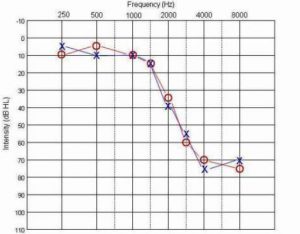
Hearing loss varies by degree and type, but high-frequency hearing loss is one of the most common. Hearing professionals define high-frequency hearing loss as hearing loss that occurs between 2000 Hertz (Hz) and 8000 Hertz. Decreased hearing in this range is often the first sign of hearing loss.

After you get a hearing test, your hearing professional will explain your test results using an audiogram. An audiogram is a graph that shows how well you hear at each frequency, which is important for speech understanding. The audiogram will show hearing within the range of normal, from 250 Hz to 1500 Hz, with results falling outside of the normal hearing range around 2000 Hz.
High-Frequency-hearing-loss.-1-300x234

Difficulty understanding speech
High-frequency hearing loss makes it challenging to understand speech in noise, and the voices of women and children, which are often higher in pitch than men. It can also be difficult to hear sounds like birds chirping, the doorbell ringing or voices over the telephone.

Frictive sounds like S, H and F are high in pitch, which is why high frequencies help with speech understanding. Tiny hair cells inside the cochlea process incoming sounds. High-frequency sounds are processed at the base of the cochlea, while low-frequency sounds are processed near the top. The hair cells at the base are more susceptible to damage, which is why hearing loss often affects high frequencies before low frequencies.

Noise, age, medications, and disease are all factors that can damage hair cells. Age-related hearing loss and noise induced hearing loss often affect the high frequencies first.

How hearing aids can help
Hearing aids are an effective treatment for high-frequency hearing loss. There are many different options available to help correct your hearing, such as open fit hearing aids and custom hearing aids with large vents that will maximize normal hearing in the low and mid-frequency ranges and amplify the high-frequency hearing affected by hearing loss. For more information, call Evolution Hearing in Charlottesville, VA at 434-260-8007 or our Raleigh, NC location at 919-670-3258, so we can help improve your quality of life.

Wednesday, 26 July 2017

Tips for Driving Safely with Hearing Loss


Does your hearing loss affect your ability to drive safely? Hearing loss, while often inconvenient and frustrating, can also be quite risky when you are behind the wheel of a car. You may be unable to hear someone honking or yelling at you to possibly get out of the way of danger. The sound cues we normally rely on while driving, such as horn honking or the ringing of a bicycle bell, become a lot harder to detect with hearing loss and they could even go unnoticed. We want to share some things that can help you to navigate the road safely if you’re hard of hearing.


Get your hearing treated. This is the best way to help you drive safely. If you haven’t had your hearing checked, but you believe you may suffer from hearing loss, don’t wait any longer to get it checked out. You may need hearing aids, which will greatly increase your hearing and safety on the road. If you already wear hearing aids, make sure you always wear them while operating a vehicle and continue to get regular hearing aid checkups.


Avoid distractions. Do not try to multitask while on the road. Put down the phone! It’s a widely known fact that texting and driving can lead to accidents, and trying to talk on the phone can be extremely distracting because you’re busy straining to hear what the person on the phone is saying. If you’re in a situation where you need to call someone or address a situation, pull over and deal with it before attempting to do so while driving.


Keep the music down. Not only does loud music damage your hearing, but it’s also a big distraction that makes it impossible to hear sound cues from the outside environment. Loud music can cause you to miss ambulance or police car sirens that are near by. These are noises you do not want to miss in case you need to move your car out of the way.


Pay attention visually. It’s always important to keep your eyes on the road, but if you suffer from hearing loss, it’s extra important because you need to use visual cues to make sense of your external environment. Pay close attention to traffic signals and always use your rearview mirror. Hearing loss makes it harder to pinpoint the relative distance of moving vehicles, so using your eyes carefully is important for protecting yourself and those around you.


If you believe you’re suffering from hearing loss please call Evolution Hearing at our Charlottesville, VA location, 434-260-8007 or at our Raleigh, NC location, 919-670-3258 to schedule an appointment today.

Wednesday, 14 June 2017

The Difference Between Cochlear Implants and Hearing Aids


You probably know what a hearing aid does, but have you ever heard of a cochlear implant?
While hearing aids are used to treat varying degrees of hearing loss by amplifying sound, a cochlear implant is used when hearing aids are insufficient. They transform sounds into electrical energy that stimulates your auditory nerve. These devices are implanted surgically and are used to treat profound hearing loss due to absent or reduced cochlear hair cell function.
 
Both of these medical devices are used to treat sensorineural hearing loss, which is the most common type of hearing loss, but hearing aids are much more common.
In fact, in 2012 the U.S. Food and Drug Administration estimated that 12 million Americans wear hearing aids and roughly 58,000 adults and 38,000 children use cochlear implants. To put those statistics into perspective, for every one person wearing a cochlear implant, there are 125 people wearing hearing aids. 
 
So how does the cochlear implant work?
It is made up of two parts: the internal receiver/stimulator and the microphone and magnetic transmitting coil. The internal receiver is surgically implanted in your ear, while the microphone and coil fit externally behind the ear and on the side of the head. The microphone picks up sound, translates it into coded signals and sends it through the transmitting coil to the implant located under the skin. Electrical energy is then sent to the electrodes in the cochlea, which stimulates the auditory nerve and travels to the brain for interpretation.
 
Is a cochlear implant right for you?
Most cochlear implant recipients try hearing aids out first. If you’ve tried hearing aids and they haven’t benefitted you due to profound sensorineural hearing loss or congenital deafness, then cochlear implant surgery may be something to consider. To determine whether or not it’s the right move, you will need to have audiologic testing, a medical exam and possible x-rays/MRI.
 
Fortunately, the majority of individuals with mild to moderate hearing loss will benefit from traditional hearing aids. Although hearing aids don’t process sound like cochlear implants, they are less expensive and can be manually adjusted, repaired, replaced and removed easily.
 
For more information on cochlear implants or hearing aids and information on how we can help you, call Evolution Hearing at our Charlottesville, VA office at 434-260-8007 or our Raleigh, NC location at 919-670-3258.

Thursday, 13 April 2017

How Heart Health Can Affect Hearing Health


Did you know that heart health and hearing health are connected?
It’s true! Research at the Medical College of Wisconsin has revealed a link between hearing and cardiovascular health. Actually, the two often intermingle. It appears that a healthy cardiovascular system has a positive effect on hearing. Because the inner ear is so sensitive to blood flow, it’s possible that abnormalities in the cardiovascular system can be discovered here before it is apparent in other areas of the body.
 This blood flow sensitivity actually means that inadequate blood flow can cause damage to your hearing. Hearing loss could even be the result of damaged blood vessels in the inner ear. Unfortunately, unlike other structures in our bodies, the inner ear lacks a backup of blood flow supply, making it vulnerable to damage.
 
Researchers at the Medical College of Wisconsin found correlations between certain audiometric patterns and arterial disease. These certain patterns could suggest the presence or potential development of cardiovascular disease. It’s an important discovery because it’s led many hearing professionals to recognize that the ear may be the window into the heart. 
 
Additional heart disease risk factors that can increase the risk for hearing loss include a sedentary lifestyle, increased body mass index and a large waist circumference. Individuals should include a hearing evaluation in their annual medical screenings if they are over the age of 40, especially if they have risk factors for developing heart disease or have already been diagnosed. 
 
To schedule a hearing test please call Evolution Hearing at our Charlottesville, VA location, 434-260-8007 or at our Raleigh, NC location, 919-670-3258 today.

Wednesday, 5 April 2017

How to Maintain Your Hearing Aids

Keep it Safe
Hearing aids should be removed every night and stored in a cool, dry place when not in use. You may want to keep them out of the reach of pets or young children because they could present a choking hazard.


Keep it Clean
You may think you need to clean your hearing aids every night when you remove them, but it may be easier to clean them in the morning. Any debris or moisture, including earwax, is more likely to dry after a few hours and is a snap to wipe off with a soft cloth. Avoid using paper tissues because they can leave behind lint.


Keep it Dry
Even if your hearing aids are water resistant, they should not be submerged in water. Do not shower or bathe while using your hearing aids, and remove them before you go swimming as well. Any moisture that can seep into your assistive devices may corrode the interior mechanics. When you take care of your hearing aids, you can extend their life and enjoy the benefits they give you. If you have more questions about the proper maintenance of your hearing devices, call Evolution Hearing in Charlottesville at 434-260-8007.


Thursday, 23 March 2017

Types of Assistive Listening Devices

If you are not always able to hear speech as clearly as you would like, an assistive listening device may be able to help. There are many types of assistive listening devices that can enhance your ability to hear live speakers, phone conversations, and television dialogue.

1063863-amp

Amplifiers

An amplifier is a device that increases sound levels while reducing background noise. Ideal for carrying with you when you are out and about. Most personal amplifiers are comparable in size to cell phones. Some utilize directional microphones, allowing you to angle them toward the sound source. Theamplified sound can then be received through a connected earpiece or headset.

FM Systems
FM systems can be found in classrooms and other learning spaces. In an FM setup, a speaker addressing a large group wears a microphone, and the captured audio is transmitted over FM radio to listeners wearing receivers tuned to the designated frequency. Personal FM systems for direct conversations are also available.

hearing-banner

Looping Systems

An induction loop system uses a thin wire looped around a room to create an electromagnetic field. When audio is transmitted through a microphone or other sound source in the room, the telecoil installed in most hearing aids and cochlear implants will automatically receive amplified sound via this field. For listeners without telecoils, wearable loop receivers are also an option.

An assistive listening device may be the hearing solution for you. For more information on different types of assistive listening devices, call Evolution Hearing in Charlottesville at 434-260-8007.


Source Link:- Audiologists Virginia